
Baby Keem just tweeted. one sentence. asking his audience:
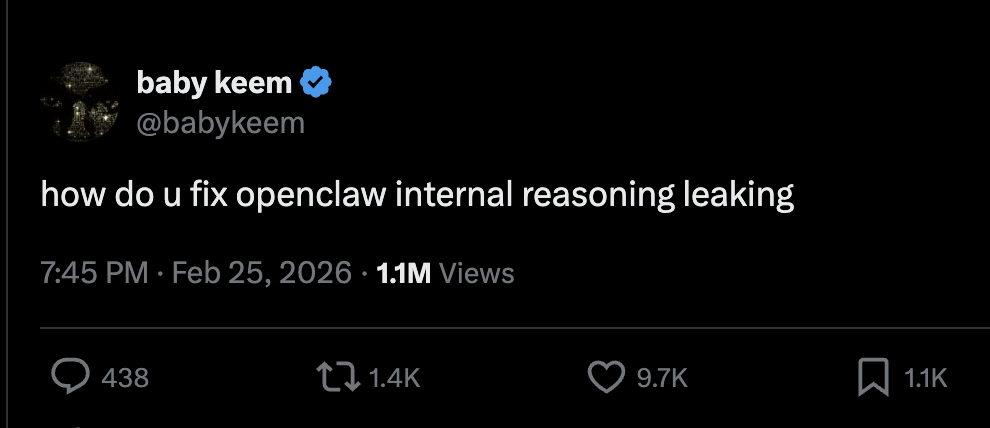
over a million views. over ten thousand likes. within three hours.
if you do not know who Baby Keem is: he is one of the most critically acclaimed rappers of his generation. Kendrick Lamar's cousin. Grammy winner. pgLang. his third album cycle is in full swing, streaming numbers through the roof. he is the definition of culture's bleeding edge.
and he is debugging an AI model. in public. to millions of people who have never heard the word "OpenClaw" in their lives.
the Kanye precedent
this reminds us of a Kanye line from years ago: "i like some of the Gaga songs. what the fuck does she know about cameras?"
that was when Lady Gaga became the creative director of Polaroid. the culture's reaction was bewilderment. a pop star... directing a camera company? the gap between entertainment and technology felt vast and unbridgeable.
that gap just closed. and the TAM just widened.
what the signal means
Baby Keem's audience is mostly non-AI-native people. they are not on the innovator's curve. they are not in the early adoption phase of what is happening with OpenClaw, Perplexity, Claude, and the rest of the frontier models nearing AGI. they are the mainstream. the culture.
and they are now problem-aware.
we checked Google Trends within three hours of the tweet. the result: a 3-5x spike in "openclaw" searches. in three hours. from one tweet. by one artist.
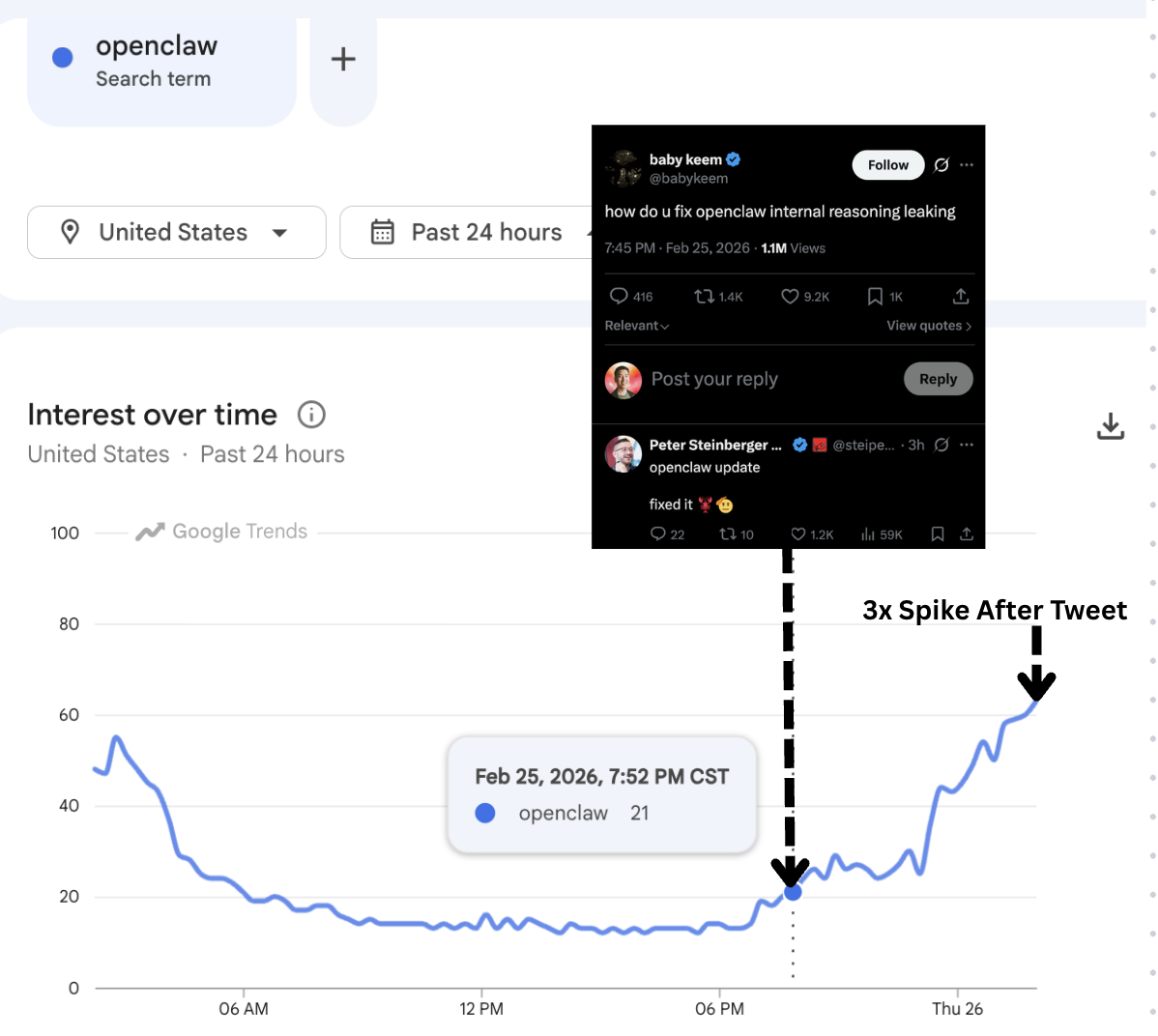
a single query from a cultural figure generated more AI awareness than most tech companies' entire marketing budgets.
this is not about Baby Keem specifically. this is about what happens when culture's tastemakers start touching the same tools that technologists have been quietly building. the signal penetrates. people repost it on their stories, not because they understand OpenClaw, but because they understand that something important is happening and they do not want to be the last to know.
the imagination economy
here is what Baby Keem's tweet really exposes: we are nearing a K-shaped economy and most people do not see the fork yet.
the divide is becoming larger. the upper class is pulling away. the middle is getting squeezed out. and the mechanisms of economic mobility that people relied on are being automated one by one:
- you do not need a CFO when AI can crunch numbers better and faster
- you do not need a COO when Operator can run your company's workflows
- the gig economy is next. when Waymo and autonomous delivery scale, what happens to the Lyft driver who was using rideshare as their bridge to the middle class?
the path forward is the imagination economy. the economy where what you create, envision, and build from nothing is the only thing that cannot be automated.
think about that word: imagine. from the Latin imago. image. we are made in the image of God, and the one capacity that cannot be replicated by any machine is the capacity to imagine something from nothing. to see what is not yet there. to create.
there won't be much economic mobility from lower class to upper class without imagination, creativity, and access to the right tools. that is the reality taking shape. Baby Keem's tweet just made millions of people feel that reality in their gut for the first time.
but this is not a reason for despair. it is a reason for hope. because the tools that amplify imagination have never been more powerful or more accessible. the question is not whether you can compete. the question is whether you know what to build.
the performance art
here is the thing: the issue Baby Keem tweeted about (internal reasoning leaking) was already fixed in a version released two days earlier. he was asking about a solved problem.
which means this was almost certainly performance art. someone on his team (or Keem himself) saw the strategic opportunity. ask a technical question about the hottest AI model on the planet. every engineer, every AI researcher, every tech-adjacent person on Twitter would rush to respond. the nerds could not help themselves. they had to correct him, help him, engage.
and it worked. in one tweet, Baby Keem separated himself from every other rapper, every other entertainer, every other Black influencer in the public eye. he is no longer just a musician. he is someone who uses frontier AI tools, and he is not afraid to show it. that positioning is worth more than any album rollout strategy.
whether or not the question was genuine, the cultural effect is the same: millions of people who follow Baby Keem are now aware that something called OpenClaw exists, that it does "internal reasoning," and that the people they admire are using it. that is marketing that money cannot buy.
the agency behind the curtain
Baby Keem does not operate alone. behind him is Project 3, the agency responsible for pgLang, Kendrick Lamar's creative collective. these are the same people behind the Ray Dalio x Cash App commercial featuring Kendrick. they have a track record of placing cultural figures at the intersection of finance, technology, and entertainment in ways that feel organic but are deeply strategic.
now consider the timing. OpenAI recently acquired OpenClaw. around the same time, OpenAI hired Charles Porch, Instagram's former celebrity partnerships executive. the talent whisperer who built Instagram's influencer ecosystem from the inside. his entire career has been about brokering the relationship between platforms and cultural figures.
we are speculating here. but the question is worth asking: could this be one of the first celebrity brand partnerships between a cultural figure and OpenAI? did Project 3 see the OpenClaw acquisition, see the Charles Porch hire, and position Baby Keem as the artist who bridges that gap?
we do not know. maybe it is organic. maybe Keem genuinely ran into a bug and tweeted about it. but the constellation of signals (Project 3's strategic track record, OpenAI's celebrity partnerships hire, the timing of the acquisition) suggests something more deliberate may be at play.
either way, the impact is the same. the TAM for AI just expanded into culture. what do you think?
if this was orchestrated, it points to an emerging formula. not just for Baby Keem, but for how cultural moments get manufactured in this new era. the meta formula is attention arbitrage: take something one world considers routine (a known bug, a technical concept, a tool) and run it through an amplifier from a completely different world (culture, entertainment, fashion, sports). the result is signal that neither world could generate alone.
Baby Keem's version: cultural figure + frontier technology + strategic naivete = massive signal. the artist asks a question they may already know the answer to. the tech world cannot resist responding. the mainstream audience watches the exchange and becomes aware of something they otherwise never would have encountered. everyone wins. the artist gets positioning. the platform gets cultural legitimacy. the audience gets initiated.
but the formula is bigger than music. imagine an athlete tweeting about their Claude workflow. a chef livestreaming recipe development with an AI co-pilot. a fashion designer open-sourcing their process with frontier tools (Virgil Abloh already showed us this play with Free Game: the creative director of Louis Vuitton publishing his entire playbook for free, embodying the spirit of open source before most cultural figures could even spell GitHub). every one of these is the same play: bridge two worlds, create signal in the gap. we may be watching the birth of a new category of influence. the people who see the formula first will define it.
the alchemical economy
we have been calling it the imagination economy. but there is another frame worth sitting with: the alchemical economy.
alchemy. the ancient art of turning base metals into gold. for centuries it was dismissed as pseudoscience. but the metaphor is exactly right for what is happening now. the people who will thrive in the AI age are not the ones with the most resources. they are the ones who can transmute what they have into something no one else can see. take the ordinary and make it extraordinary. take raw signal and turn it into gold.
Baby Keem's team took a tweet about a bug and turned it into a cultural moment. that is alchemy. the creative who takes AI tools and produces something that moves people. that is alchemy. the visionary who sees a broken system and reimagines it entirely. that is alchemy.
imagination economy. alchemical economy. maybe they are two names for the same thing. the economy where the only currency that matters is your ability to create something from nothing.
the window
for Baby Keem, the timing is strategic. he is in his album cycle. streaming is up. for him to spend marketing capital on an OpenClaw tweet means (whether as a genuine user or a strategic performer) he understands that AI is now cultural currency.
for the rest of us, the window of opportunity is real but it will not stay open forever. a lot of people are going to capture the upside of this moment. to create things that are viable and profitable. to leverage their unique skill set and imagination. to build astronomical wealth if positioned correctly.
the people who move first, who are problem-aware before they are problem-overwhelmed, who have access to the tools and the taste to deploy them correctly: those are the people who will define the next era.
everyone else will be asking "what is OpenClaw?" six months too late.
our assessment
this is a signal moment in the convergence of culture and AI. it represents:
- mainstream problem-awareness hitting an inflection point. the curiosity gap is closing.
- cultural legitimacy for AI tools. when Baby Keem tweets about OpenClaw, it is no longer a niche tech thing. it is culture.
- urgency for the "hungry middle": the people who are successful enough to know they should be paying attention, but have not yet made their move.
- the dawn of the imagination economy: the future belongs to people who combine creative vision with technical leverage. we are made in the image of God. the capacity to imagine is the one thing the machines cannot touch. Baby Keem is exercising that capacity in public. your move.
this situational assessment was produced by Project Hyperagent. we shepherd visionaries during this Great Transition.